


You might have read or heard that scientists have come under immense pressure ever since the pandemic, and specifically the second Trump administration. Given the dizzying array of outrageous news, authoritarian actions, war propaganda, brutality and blatant corruption scandals, it is easy to lose sight of the longer-term trends on some generational changes happening around us.
I’ve spent the last few years interviewing scientists and science advocates who have found themselves in an uncomfortable place they never asked to be: At the front row in the fight to resist autocratization. Many other scientists became targets of motivated actors and agendas not by defending their research or their area of expertise, but defending the principle of a shared, objective reality itself.
So I’d like to start with a bit of a data-driven summary of what has happened to US science since January 2025 on two dimensions, vaccines and science funding, using a tracking and database tool created by Prof. Christina Pagel. Her Trump Action Tracker is extremely handy to zoom out to the larger picture and find the patterns behind the often chaotic and random-seeming day-to-day evils of the current regime.
Let’s just take a look how a federally-empowered anti-science movement has wreaked havoc in the vaccine space in the last 15 months, shall we?
Attacks on vaccines and immunization
From around 680 tracked action items pertaining to attacks on science and education, around a 115 have been focused on vaccine science, immunization, vaccine regulation or related topics. Here is a cumulative graph with vaccine actions highlighted, and a second visualization with labels showing the most severe actions based on population impact.
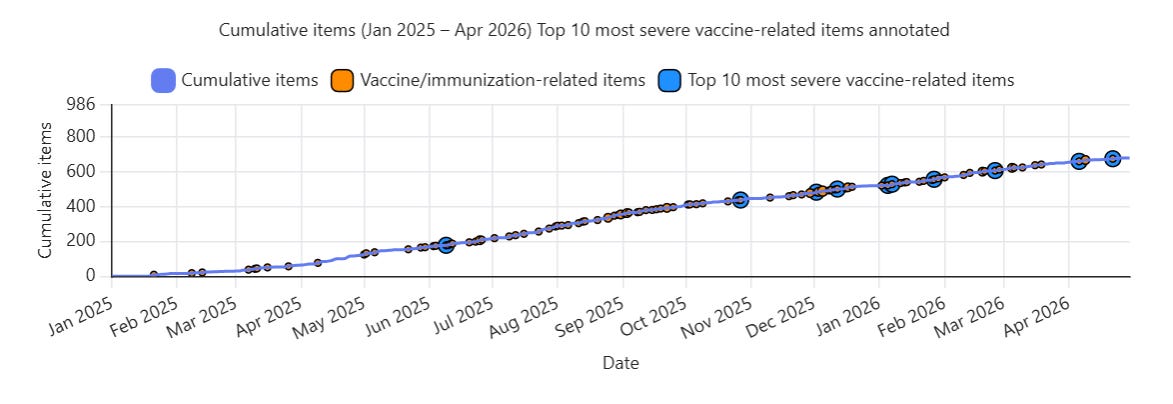
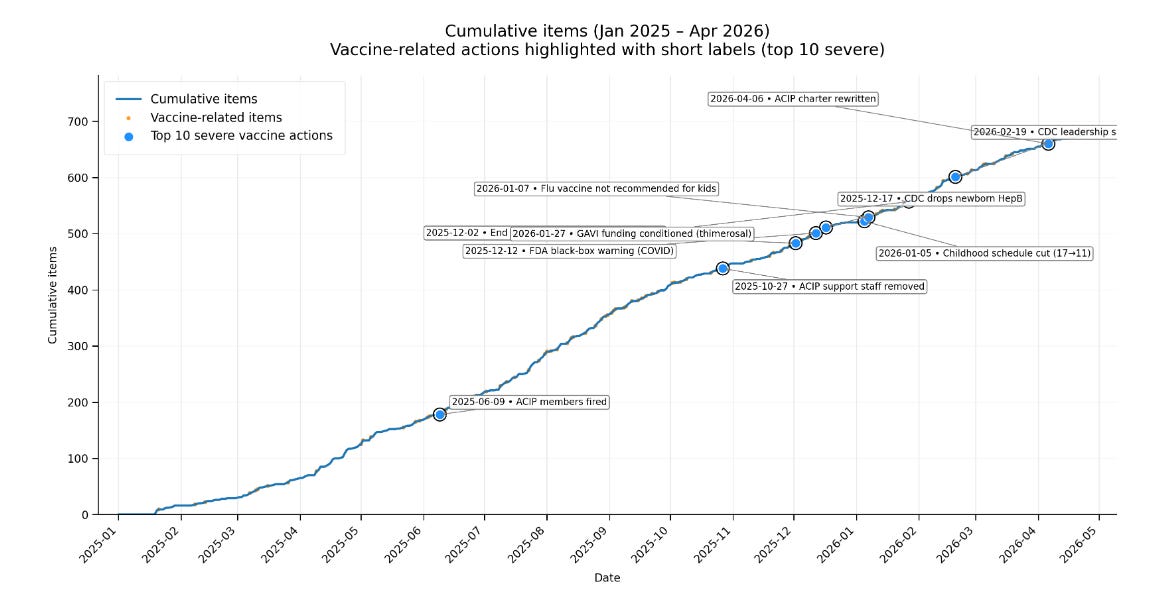
If anybody is interested in what the most severe actions are, here they are listed again with some comment about impact and at least one reporting source.
2025‑06‑09 — HHS Secretary fired all 17 members of the CDC Advisory Committee on Immunization (ACIP) (major institutional capture / undermines evidence-based schedules). Source.
2025‑10‑27 — Entire staff supporting ACIP (plus ethics/HR) let go (operational sabotage affecting national vaccine policy function).
2025‑12‑02 — New ACIP chair states panel plans to vote to end universal hepatitis B vaccination at birth + scrutinize childhood immunizations (population-wide immunization schedule change risk). Source.
2025‑12‑12 — FDA intends to add its most serious “black box” warning on COVID‑19 vaccines (high-impact guidance/regulatory signal with broad downstream effects).
2025‑12‑17 — CDC ends recommendation for all US newborns to receive hepatitis B vaccine (broad access/guidance removal for a major population segment). Source
2026‑01‑05 — Dramatic revisions to vaccines recommended for American children; disease prevention reduced from 17 to 11 (large-scale immunization schedule contraction). Source
2026‑01‑07 — CDC changes include no longer recommending flu vaccine for children; public messaging implying “better” if fewer children receive it (broad guidance removal affecting uptake).
2026‑01‑27 — Conditioning funding for global vaccine group GAVI on phasing out thimerosal-containing shots (major foreign-aid / global population impact). Source.
2026‑02‑19 — NIH director Jay Bhattacharya named acting CDC director; concerns about advancing new vaccination restrictions (leadership capture with policy consequences).
2026‑04‑06 — Rewriting membership rules for key vaccine advisory panel (ACIP) (structural change enshrining long-term institutional shift). Source.
One clear larger pattern we can spot above in our analysis is the subversion of ACIB, first by firing scientists and career professionals, before replacing them with regime loyalists that start rolling back vaccine recommendations, then vaccine access locally and globally, and lastly rewriting rules to enshrine anti-vaccine policy in institutions.
“Anti‑science activism is now a major killing force in America. … more than 200,000 Americans died needlessly because they refused COVID vaccines.” — Peter Hotez, Baylor College of Medicine
“The damage has been done and it’s so extensive that we’re talking 10, 15 years with a transfer of power to get it all back.” - Gregg Gonsalves, Yale School of Public Health
This is of course only one area of anti-science that the Trump administration, Acting CDC Director Jay Bhattacharya, and HHS Secretary RFKjr. and the MAHA movement have worked hard to dismantle and subvert. Here is another:
Attacks on scientific funding
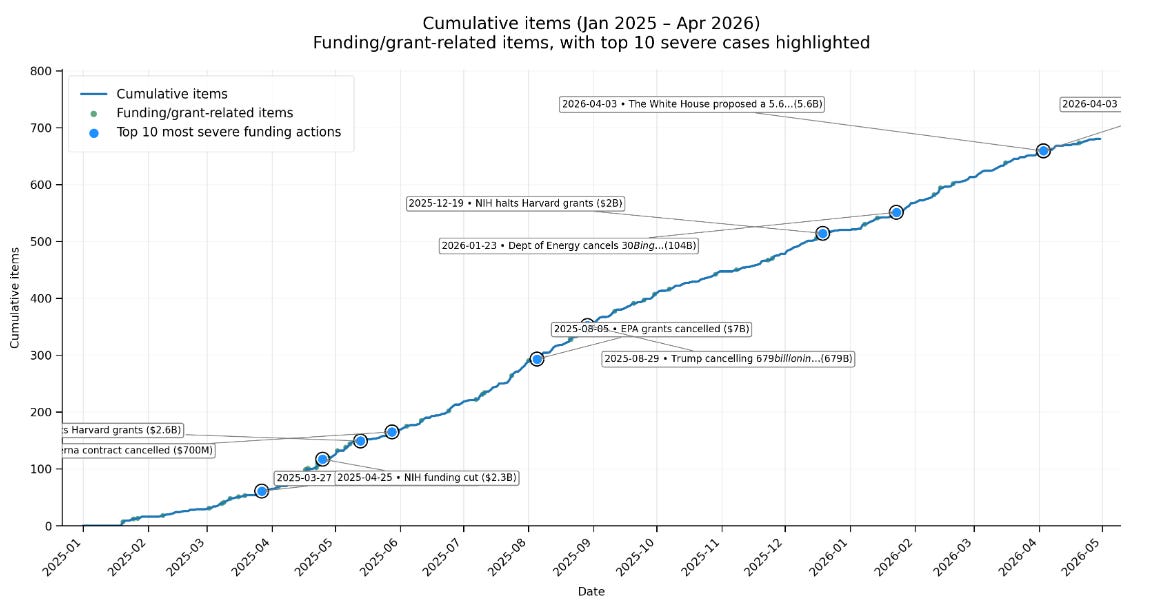
2025‑03‑27 — HHS cancels $12B in state health grants (infectious disease + mental health + addiction services)
2025‑04‑25 — NIH funding reduced by $2.3B (infectious disease, heart/lung, fundamental biology)
2025‑05‑13 — Harvard suffers grant cuts to total of $2.65B
2025‑05‑28 — HHS cancels $700M Moderna contract for pandemic‑risk flu / H5 vaccine work
2025‑08‑05 — EPA moves to cancel $7B in solar grants (low/moderate income households)
2025‑08‑29 — Federal offshore wind funding cancellations: $679M
2025‑12‑19 — Appeal re: termination of >$2B Harvard grants and research funding restriction
2026‑01‑23 — DOE cancels $30B green loans and revisits $53B more (total $83B)
2026‑04‑03 — White House proposes $16B HHS cuts incl. $5B from NIH
2026‑04‑03 — White House proposes $5.6B NASA budget cut incl. $3.4B science cut
Across scientific agencies such as NASA, NIH, EPA etc and federally funded universities (Harvard, Columbia…), also governmental departments such as the Department of Energy (DoE), ideologically motivated funding cuts and re-allocations are used to dismantle unwelcome science. Where that US Congress-allocated money goes is also not clear, but part of it will likely find it’s way to filling the pockets of regime-aligned beneficiaries; from Trump family and loyalists to big tech and fossil fuel interests.
My larger point is that the US science infrastructure, which was previously world-leading, is being dismantled and subverted by a fascist machinery and anti-reality movement at a speed and scale, and with a level of corruption, that is hard to conceptualize. The consequences will be direly felt by US citizens and around the world today and for generations to come.
“We’re going to see a lot of dead people … and a lot of new infections.” — Gregg Gonsalves, Yale School of Public Health
“The scary thing isn’t that they are extremists. It’s that everyone else starts accommodating them.” - Christina Pagel, University College London
The destruction of US science by the administration and the anti-science movement have mostly been met by media pundits, business elites and large parts of Trump supporters with apathy, or even tacit support.
The COVID-19 pandemic seems to have soured too many of those interest groups and powerful discourse shapers on scientists having any public voice or influence in public discussions. Especially on society-relevant topics such as technology, health, environment, defense and the economy, where scientists might contest political or business narratives with evidence and expert authority, few of those discourse shapers feel the need to speak up in defense of science.
An often quoted idiom of the billionaire-friendly pundit class and rightwing media machinery (and the NYT columnist section too) contests that “scientists themselves are to blame” for the loss of trust; that they either made too many mistakes, are ideologically captured by self-interests, brainwashed by democrats or leftwing institutions, or are part of multiple devious conspiracies, from big pharma to the deep state.
That at least a sizeable minority of ordinary US citizens believe some version of that absurd narrative is remarkable given that polls and surveys show that MOST PEOPLE STILL TRUST SCIENTISTS MORE THAN ANY OTHER GROUP.
I believe it speaks to the asymmetric power of discourse shapers to bring minority opinion to dominate not only public perception, but also political realities. Most US citizens and even Congress do not want NASA defunded, they do not want cancer research defunded, they do not support the dismantling US science, and they sure as hell want access to vaccines for their children.
So how does the anti-science crowd get away with it, in government and in discourse, against such strong public support for science?
These are hard questions that we tried to understand in our conversations at Science Counterpunch. So I wanted to drill down a little bit on some larger patterns between what the scientists, science activists, and science communicators we had on told us and maybe extract some learnings.
Writing often helps me think, and hopefully these lessons I gathered from my interviews can be useful for anybody who wants to understand or get active in the defense and support of science and scientists.
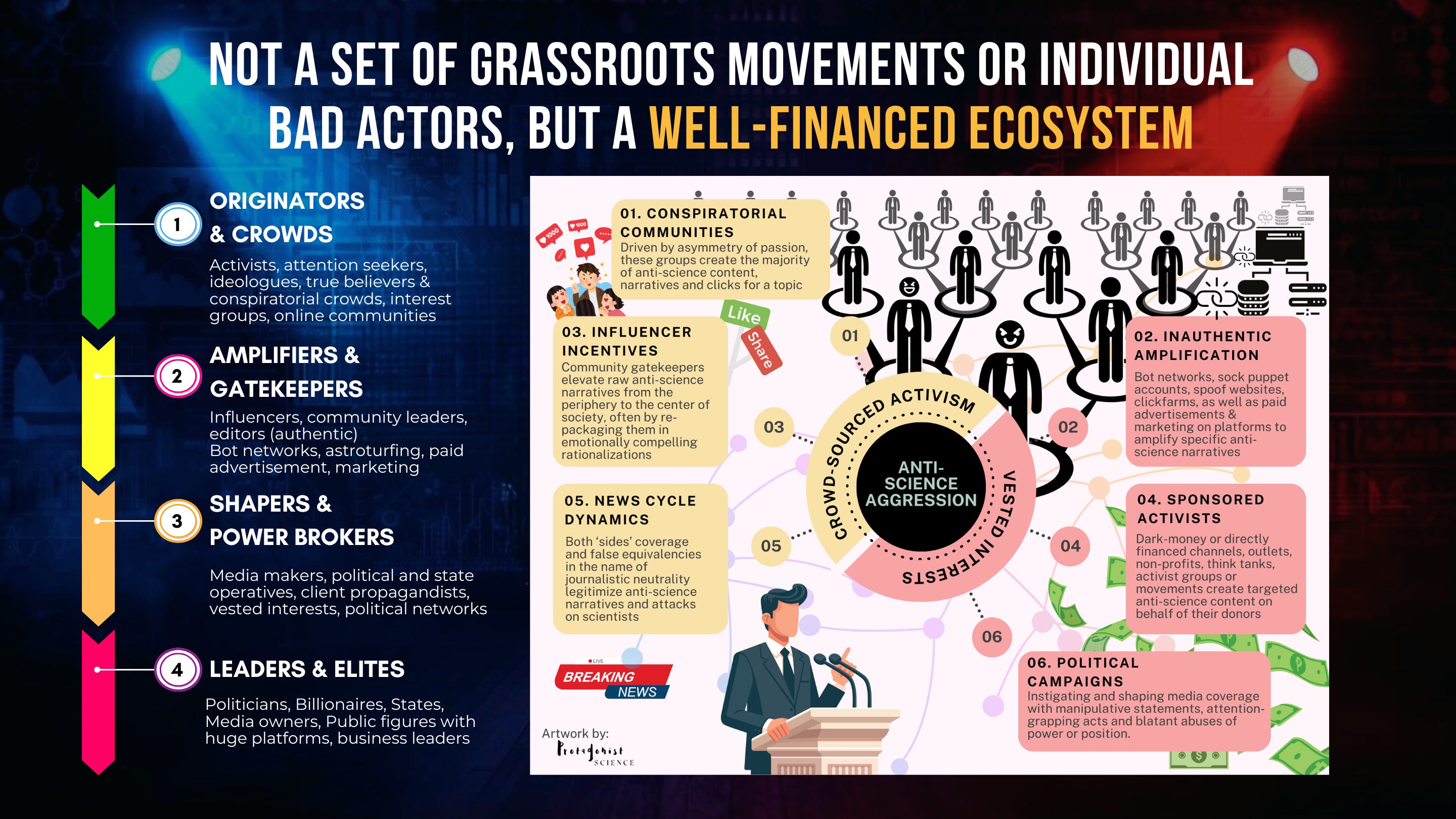
Here is the visual TL;DR summary of what defenders of science need you to know about the modern anti-science movement, it’s tactics, and why we can’t expect scientists to solve the problem without our support.
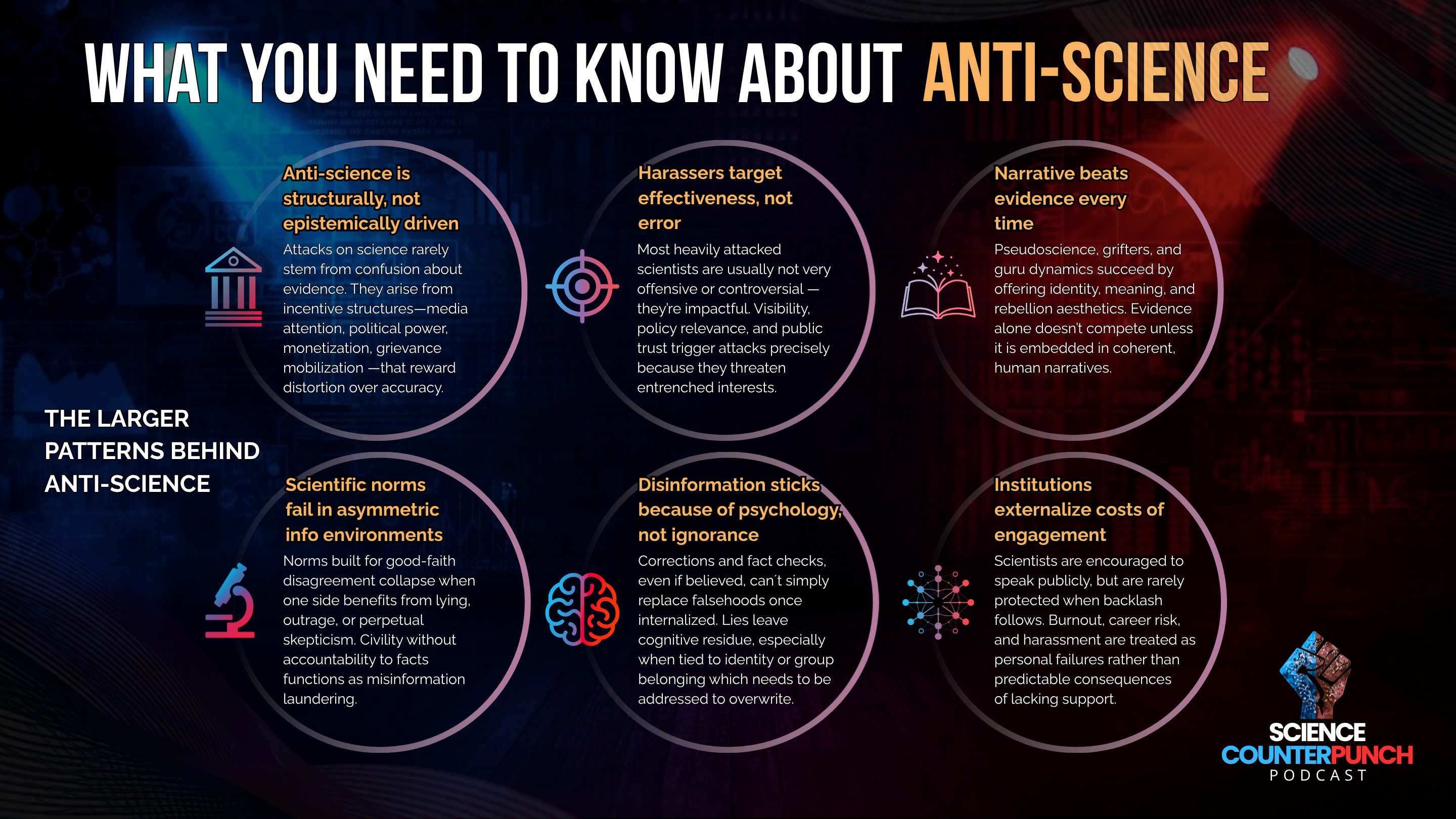
1) Anti-science is structurally, not epistemically driven
I think the first, and maybe most important key lesson is this: attacks on science or scientists are rarely driven organically; nor are they caused by confusion, error or poor science communication.
They are driven by vested interests and political power and the incentive structures they create through money, ownership, regulation, class and ideological networks, and governmental policies. Oligarchic platforms, vested industry interests, attention dynamics, culture war politics, monetization, grievance mobilization; all these incentives reward distortion of science and punish those who speak truth to power with science and evidence. Two of our guests, the esteemed scientists Michael Mann and Peter Hotez, have written a whole book about this, so I think it’s worth spending a few more words on this.
In the information age, those who get to shape what information people see, hear, consume or are exposed to wield power. Be it platform owners, influencers, politicians, media elites, power brokers or just conspiratorial or activist crowds that disproportionally participate online and get rewarded by algorithms for it.
Since I have written and spoken about how modern anti-science functions multiple times before, I will just leave you with another figure below on the eco-systemic nature of that anti-science media machinery.
“There are three things that create accountability in a democracy: the media, the justice system, and science. All autocratization processes will go after those three aspects of society.” - Steve Lewandowsky, University of Bristol
Now, all fascist movements and most autocratization processes include attacks and ultimately the dismantling or subversion of science, evidence and any notion of accountability or objective truth. So the Trump administrations actions very much follow this playbook.
“This government has, led by Trump, entirely decimated the scientific ecosystem in the United States.”
— Colette Delawalla, Founder and CEO Stand up for Science
But that authoritarian playbook is not the whole story, because the anti-science ecosystem does not only operate at the level of government, but in public discourse, in online communities, in business, in religion, your doctor’s office and anywhere else where people can be reached.
Sometimes the inner workings of this anti-science machinery are obvious: anti‑vaccine entrepreneurship, “medical freedom” politics, or influencer profiles built on contrarianism. Sometimes it is quieter: the erosion of institutional norms, the lobbying against unwelcome laws and regulations, and the steady casting of expertise as corruption all converge to remove science as a tool for accountability against the currently powerful.
Most perniciously has been when seasoned anti-science grifters collaborate with the fascist movement to get into position of institutional power at scientific agencies, keeping the veneer of a somewhat functional institution but re-shaping it into a tool of propaganda, voter manipulation, and ideology; which is what happened not only with RFKjr and MAHA for HHS and vaccines, but across most federal agencies; from NASA to NIH, from CDC to EPA.
“These groups figured out that if you control the agencies, you control the narrative.”
— Peter Hotez, Baylor College of Medicine
The anti-science ecosystem has not only grown by its alignment to the fascist political MAGA movement, its rightwing media machine, and vested business interests, its now an essential part in furthering their agenda and enshrining their power.
Scientists that for decades enjoyed public trust and bipartisan support are obviously getting steamrolled and few have yet realized what formidable evil empire they are even up against.
“We’re not even in the fight. We’re literally bringing scientific and policy papers to a fucking war.”
— Colette Delawalla, Founder and CEO Stand up for Science
It’s high time for the rebel alliance to come together. If you need any pointers, I recommend checking out Colette Delawalla’s interview at the end of the article.
Let´s hammer the main point home:
Anti-science in its current iteration is not organic, not ordinary people, not justified. It’s an ecosystem that rewards its participants and funders in various ways for shielding power from the democratic accountability that science provides.
2) Harassers target effectiveness, not error
I think another very clear pattern appears when looking at who gets targeted by the anti-science ecosystem and its media machinery.
The scientists most aggressively harassed across fields are rarely the most controversial or somehow sloppy with their data. The opposite: They are often the most effective communicators or have the most relevant expertise to speak publicly with authority on a topic.
“The people who get attacked aren’t the ones quietly doing bad work in a lab. They’re the ones whose voices reach outside the silo.” - Dan Wilson, Debunk the Funk
Harassment, across domains, follows a shared script to coerce outspoken scientists into silence.
Question legitimacy – undermine credentials, motives, or integrity of scientists when they speak up about their expertise
Isolate the scientist – portray them as partisan, controversial or ideologically suspect and demand their institution and social contacts distance themselves (Mike Mann calls it the Serengeti strategy)
Escalate harassment – threats, abuse, institutional complaints, lawsuits to intimidate and create multiple pressures for outspoken scientists
Wait for silence – few people can withstand sustained attacks over a long time without support. Most often, pressure campaigns lead to job loss or resignation, public withdrawal, or self‑censorship.
The goal is not to prove the scientist wrong. It is to make public engagement too costly to sustain. It’s a tactic of repression, of coercing the most informed into silence. There is also a chilling effect beyond the individuals targeted.
Many scientists might feel it is not worth the risk to continue speaking up about their research or evidence-based decision-making, certainly not in public.
And that is the whole point.
3) Narrative beats evidence (every time)
A recurring theme in online spaces is that storytelling is powerful.
We humans are a story-telling species. Stories help us navigate life by reducing the complexity of the natural and social world and maintaining social bonds or group-level cooperation. Storytelling represents a key element in the creation and propagation of culture, it is how we make sense of non-routine, uncertain, or novel situations.
Our Decoding the Gurus guests Chris Kavanagh and Matt Browne observed that “secular gurus” succeed not by insights but through anti‑institutional narratives. They position themselves as having answers to complex questions of science that the “mainstream” keeps from them. They spend hours building elaborate stories and spinning conspiracy myths.
Another thing that differentiates gurus from ordinary public intellectuals is the scope and width of their stories and supposed knowledge to help us make sense of the world.
“Public intellectuals are very clear about the limits of their expertise. Secular gurus don’t do that. They add strategic disclaimers, but the performance is certainty.” - Matt Brown, Decoding the Gurus podcast
Their stories offer their audience rebellion aesthetics: the thrill of insider knowledge without the cost of actually learning how things work. Even a role in a moral drama: the awakened dissenter, the persecuted truth‑teller, the heroic minority fighting the good fight against mainstream science.
Sensationalist, intriguing, emotional, or outrageous stories can shape public conversations, even when they are baseless, speculative, or plainly false. Stories as sense-making devices are full of peripheral cues such as familiarity, processing fluency, and cohesion which create an “illusory truth effect”
For a very long time, this power of storytelling has been used by leaders, powerholders, and manipulators alike to further their goals. Media manipulators are interested in creating and selling engaging stories for their bottom line, and science is often an enemy to those efforts because of its debunking potential. So discrediting mainstream science and scientists is part of the business strategy of storytellers.
On top of that, science suffers a dramatic disadvantage when it comes to storytelling because it is bound by fact. Evidence is slow. It is also often nuanced, jargoned, and hard to explain to non-experts. It demands caveats.
“I think you are at a bit of an inherent disadvantage when you’re constrained by the truth.” - Matt Brown, Decoding the Gurus podcast
There is a million ways to make a story more compelling by using fictions; there is decidedly less ways when sticking to facts.
Pseudoscience can provide narrative clarity, moral drama, or the promise of personal awakening. Against that, evidence presented without narrative context struggles. A fiction well-told is more compelling than a set of amazing facts delivered with scientific rigor.
Most anti‑science successes are not driven by fact-finding failures of mainstream science; they are driven by contrarian storytelling victories.
4) Scientific norms utterly fail in asymmetric environments
Online ecosystems are mercurial, capitalistic, maybe even somewhat meritocratic, within their own logic. They monetize outrage, reward spectacle, and build identity-based loyalty. Information is a product to sell, not to educate. Those who do it best profit the most. Truth is incidental at best—and often a liability.
Channeling the feelings of audiences is what matters, not having the best or most accurate information. Scientific caveats, articulating nuance, uncertainty and limitations are inherent to scientific process and accurate communication, but they make for rather poor or dry content.
Many of our interviewees began their public engagement careers believing that their deep expertise, paired with good faith engagements, would be rewarded, or at least reciprocated. They rarely were.
“You can leave in the uncertainty, you can explain carefully—but shouting matches outperform patience every time in that environment.” - Prof. David Kipping, Cool Worlds YouTube channel
Traditional scientific discourse and civility norms fail in such an asymmetric media environment.
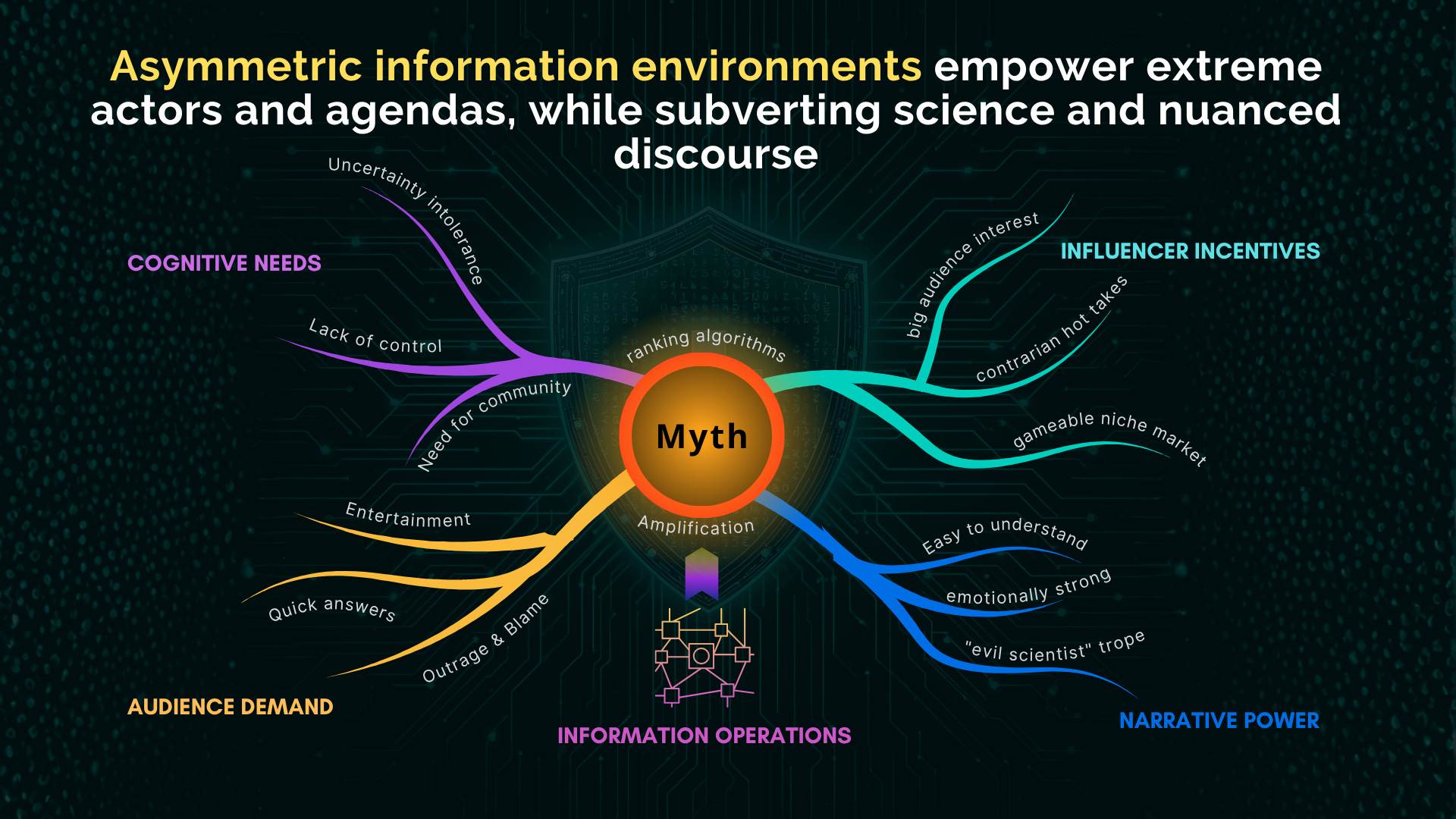
Science finds itself at systematic disadvantage, while that asymmetry profoundly shapes the nature of what content gets produced, what content gets seen, and what characters rise to the top of the attention economy.
“Being an edgelord works. It gets attention, it gets clicks, it gets invited on platforms.” - Flint Dibble, Archeology with Flint Dibble YouTube channel
“Everything needs to be clickbaited… We just want the clicks. We want the money.” - Kayleigh Düring, History with Kayleigh YouTube Channel
Another problem of asymmetric media environments is that they are profoundly unequal, following a “rich-get-richer” dynamic or power law distribution of attention. That means once a critical mass of attention has been reached, algorithms constantly deliver new, unsuspecting users while platforms reshape social graphs into “interest” communities around shared narratives. And once there is “audience demand” for a particular “interest”, the supply side will follow.
Given the vast amounts of money flowing into cultivating audiences and creators for the anti-science ecosystem over the last years and decades, a critical mass of misinformation merchants has built a now self-sustaining cottage industry of deception that will not go anywhere anytime soon.
“Charlatans have gotten better and better and better at building businesses from online grifting.” - Dave Farina, Professor Dave explains YouTube channel
Into this well-oiled machine of motivation, monetization and manipulation, you throw in scientists with their inconvenient facts and appeals to evidence-based discussion and expect it to go smoothly for them? Good luck.
The only thing less helpful than being left to our own devises in fighting these grifters is mainstream press implanting themselves as supposed neutral mediators of the conflict.
Giving equal airtime to radically unequal claims, adopting the grifter’s framing of the issue, tripping over themselves to sanewash, whitewash or otherwise rationalize the words and actions of grifters to put them in the best light and most cheritable interpretation are deeply harmful acts.
And the press’ reason for it are so petty and self-absorped; it’s to simulate an outdated journalistic ethos of their own “view from nowhere” neutrality, that they take no sides, have no stakes, and no skin in the outcome. All they end up doing is being played for suckers.
“False balance. Performative neutrality, sort of two sides of the same coin. And it has been completely exploited by bad actors.” - Mike Mann, University of Pennsylvania
When one side profits from propaganda, perpetual skepticism, and bad-faith arguments, the norms of polite debate collapse. Civility in arguments without accountability to factual reality becomes disinformation laundering — and repeatedly re‑platforming bad actors by mainstream press eager to display performative neutrality legitimized them as reasonable interlocutors when they are anything but.
5) Disinformation sticks because of psychology, not ignorance
One of the most frustrating realizations for scientists and science communicators alike is that misinformation does not evaporate once a claim is labeled false, corrected, or debunked, even if the correction is taken up by audiences. This is not a deficit of intelligence or education. It is a feature of human cognition. Once an idea enters memory, it continues to exert influence even after it has been consciously rejected.
“It’s very difficult to unbelieve things. Once you’ve heard it, it’s in there.” — Prof. Stefan Lewandowsky
People may acknowledge that a claim is false — and yet they still continue to reason as if it were true minutes later.
Repetition compounds the problem: familiar ideas feel more credible, regardless of accuracy. Add emotion, identity, or narrative coherence, and even consciously rejected, but internalized falsehoods gain an undue influence on our minds and decision making.
This has profound consequences in an information environment optimized for repetition, novelty, and emotional reward driving virality.
“I was depressed and I was disabled… all I could do was sit or lay around… and that makes you watch a lot of YouTube” - Kayleigh Düring, History with Kayleigh YouTube Channel
Disinformation is more prevalently believed in spaces where scientists rarely show up or are seen; from entertainment to online communities and social platforms.
Disinformation does not need to be elaborate to be effective; it only needs to be circulating faster to reach people that have not been exposed to alternative explanations and thus internalize it as knowledge on a topic they might never have thought about before.
Corrections, by contrast, are cognitively expensive: they demand attention, motivation, and trust, all of which are in short supply in todays information age. Scientific explanations don’t have to beat disinformation on accuracy, but speed. That’s why pre-bunking has been one of the more promising interventions studied so far.
6) Institutions externalize costs of engagement to individuals
The lack of courage and silence from institutions may be the most damning pattern of all for individual scientists that come into the crosshair of the anti-science movement.
On the one hand, scientists are encouraged to engage publicly by their intuitions. Grant proposals reward “broader impact.” Universities praise public visibility and might even recruit students and faculty based off it. Journals celebrate influential voices speaking up against power. But when backlash arrives, the costs are privatized.
Harassment, burnout, and career risk are treated as personal resilience failures rather than predictable system outputs.
“We had mass movements. Now we tell individuals to be brave—and leave them alone when things go south.” - Gregg Gonsalves
The message this sends is unmistakable: public engagement is encouraged in theory, but unsupported in practice. The system praises courage abstractly, yet engineers conditions where the rational response is silence.
Institutions often justify this abdication by invoking non‑partisanship, academic freedom, or liability concerns. In reality, these explanations collapse under scrutiny. Choosing not to protect scientists facing coordinated harassment is not apolitical; it is a political choice with dire consequences. It cedes ground to actors who understand that asymmetric pressure works — and that institutions will look away.
The result is a tragedy of collective action. Each institution acts as if the problem of scientists under attack is marginal, exceptional, or external. In aggregate, their inaction normalizes intimidation as a cost of doing science in public. What should be treated as an attack on the integrity of knowledge production that required collective action get quietly reframed as a problem or failure of individuals.
As long as institutions continue their abdication of responsibility, calls for better science communication or more public engagement will ring hollow. You cannot ask individuals to defend science and reality while denying them collective backing when the predictable harassment arrives at their feet.
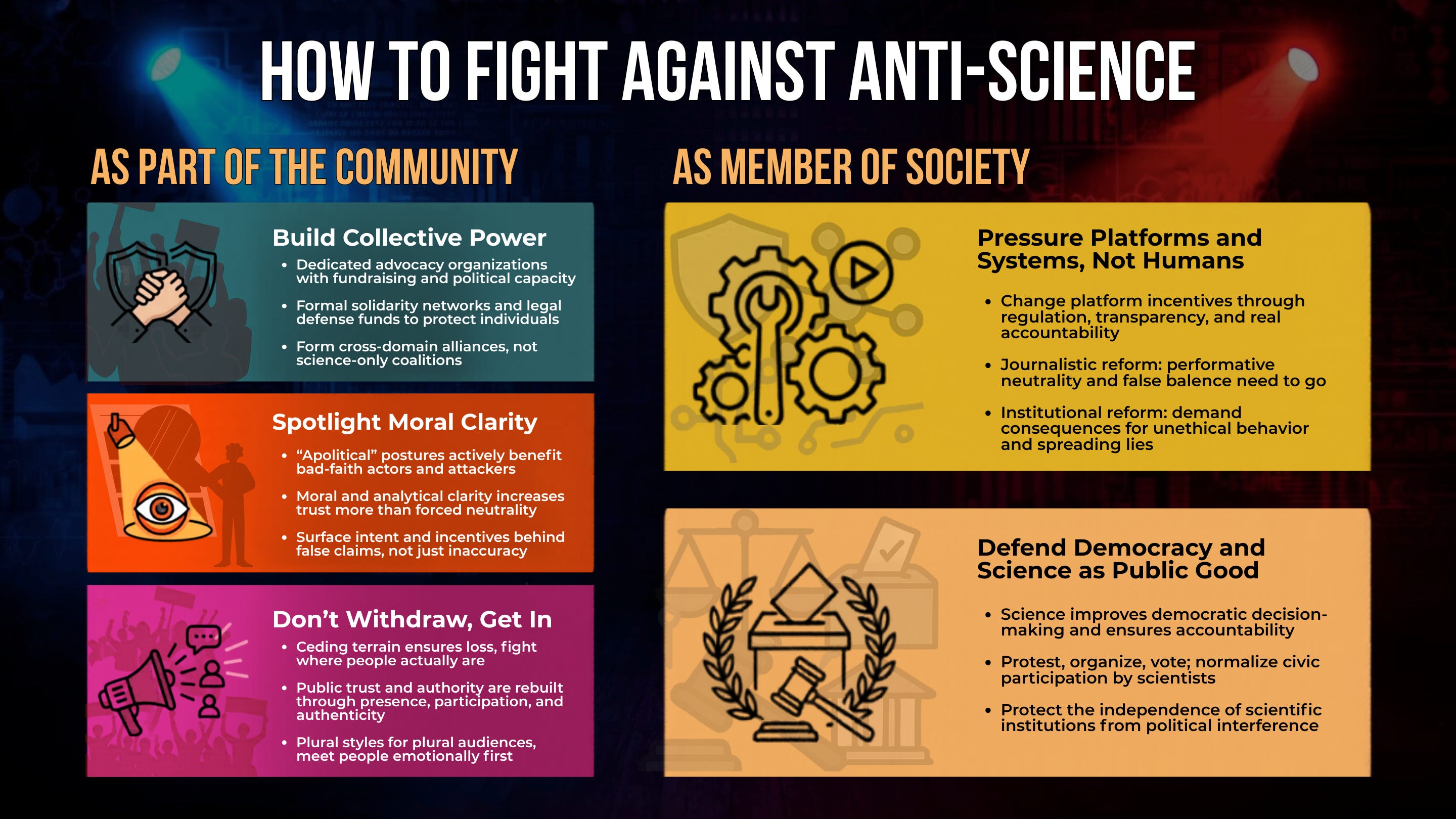
What can be done to fight back?
This has been one of the key questions that I have been occupied with for at least the last five years and that I also posed to most, if not all, of my interviewees out there fighting the good fight. So of course I am not gonna leave you without some actionable solutions to our current problems. In fact, that is the whole point of our Science Counterpunch community.
As you can imagine, there were many fascinating answers, first-hand experiences and practical ideas out there. As my first analysis on the solution space, I tried my best to categorize and group them, look for commonalities across and boil them down drastically to what I believe is a set of broadly agreed actions. There is no single solution, but a set of things we all probably should have been doing years ago and need to start doing today.
Below is again the visual TL;DR summary. I will keep writing and talking more about this in the future, but check out all our interviews below and let´s wrap this long article up.
The growing gap between science and society
Over the last few years, we have seen the gap between science and society widen. While most citizens around the world still believe that scientists are trustworthy and work for the public good, a lot of noise and doubt has been introduced into that relationship by a well-funded, manipulative anti-science ecosystem. We can see the cracks in funding, vaccination rates, muted responses and apathy to a fascist movement feeding US science into the woodchipper.
“Doubt is our product”, has the tobacco industry famously coined. With the modern anti-science juggernaut, we are at this point again. And we seem to be heading faster and faster in the wrong direction, both scientists and society can feel it.
Scientists alone can not defeat an anti-science machinery they did not create. What we can do is ask for help. Give guidance. Start acting and hope others will join.
So to me, the real question of this moments seems no longer whether science can explain itself better to society, but whether society is willing to defend the conditions under which evidence-based discourse, and with it science and democracy, can still exist.
The answer is up to all of us.
PS: If you want to hear more from people who fight back against anti-science, all our interview conversations are freely accessible:
Thank you, Dr. Markolin, for this. As an oldster Humanities kinda guy, I've been interested in science since age 7. During the 1970s I became convinced that that the advent of Modern Science (17th c.) has done far more to make the world a better place than any other area of intellectual thought. Furthermore, it drives economics and real wealth. To see a group of know-nothing clowns and chumps attack it from all sides by "hacking" mass psychology is a daily horror that, speaking candidly, I tend to turn away from because the stupidity is so withering. I retreat to my study.
But I will be writing about this. I am your ally. And I'll no doubt be using some of the richness you present here when I do so.
Thanks again!
Thank you so much for this! What a great overview! It's a must-read for every scientist, science society and concerned layperson. I've been fighting this battle for quite a while and very much appreciate your efforts.